Collection HDA hda-sl01@hongdapt.com Online message Site Map Hello, welcome to hongda spray-painting machine electric official website!
Sales of HONGDA spraygun We specialized in manufacturing electrostatic spray guns
+86 13622624429

+86 13622624429
Contact person: Ms Croesus
0769-81885105
Phone: +86 13622624429
E-mail: hda-sl01@hongdapt.com
Skype: hongdapt@outlook.com
QQ: 1550167687
Factory: Block A No336, Changqing North Road Chanan Town . dongguan China
Hotline:+86-13622624429
The liquid paint electrostatic spray gun is a subcategory of the electrostatic spray gun, and their core
differences lie in applicable coating forms and
structural configurations.
An electrostatic spray gun is a general
term covering both liquid and powder types. The liquid paint electrostatic
spray gun is specifically designed for liquid coatings (solvent-based,
water-based paints, etc.) and does not have powder spraying functions.
Core
Differences
1.Applicable Coatings: The liquid paint electrostatic spray gun only handles liquid
coatings such as solvent-based paints and water-based paints. The general
electrostatic spray gun has a broader concept, including both liquid and powder
types, and the powder type requires equipment like a curing oven.
2.Structural Configuration: The liquid paint electrostatic spray gun is usually equipped with
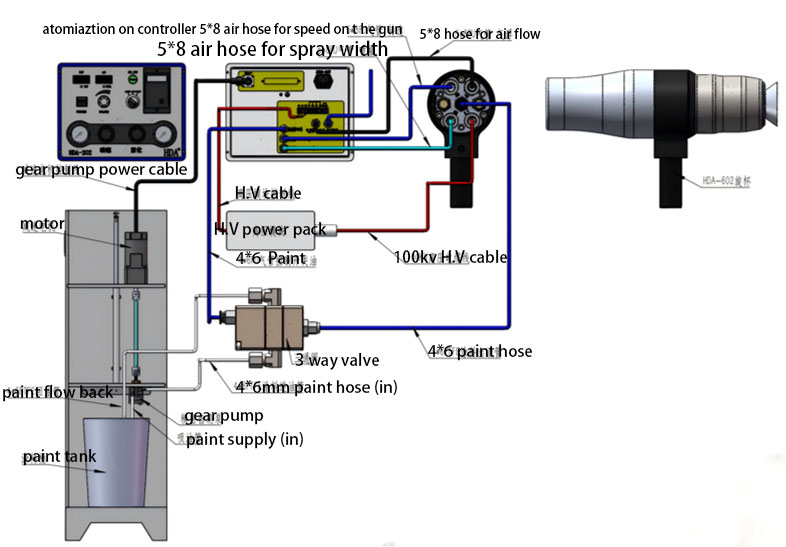
a paint supply pump (such as a pneumatic double diaphragm pump), paint
pipelines and nozzles. The powder electrostatic spray gun uses a powder hopper,
powder pump and Venturi tube to convey powder, with significant structural
differences.
3.Application Scenarios: The liquid paint electrostatic spray gun is mostly used for fine
surface coating of conductive materials such as hardware, auto parts, home
appliances and 3C electronics. Electrostatic spray guns correspond to liquid
spraying or powder spraying production lines according to their types.
Dimension
Liquid Paint Electrostatic Spray Gun
Electrostatic Spray Gun
(General Term)
Coating Form
Liquid (solvent-based, water-based)
Liquid or powder
Typical Aliases
Electrostatic paint spray gun, electrostatic oil
spray gun
Electrostatic spray gun,
electrostatic powder spray gun
Feeding System
Paint supply pump, paint pipeline
Liquid type uses a pump; powder type
uses a powder hopper and powder
pump
Application Scenarios
Fine surface coating of conductive materials
Liquid coating or powder coating
production
line
Optimization Scheme for Selection and
Practical Application of Liquid Paint Electrostatic Spray Gun
1. Scheme Background and Core
Positioning
In the batch coating scenarios of
conductive workpieces such as hardware, auto parts and home appliances, many workshops
have long faced pain points including low coating utilization rate, exposed
primer at film edges and corners, and large color difference in the same batch.
This scheme clarifies the boundary differences between liquid paint electrostatic spray gun and the
generalized electrostatic spray gun, and provides implementable full-process
guidelines for production lines covering model selection, commissioning and
operation & maintenance, so as to take into account both coating quality
improvement and comprehensive cost control.
2. Definition of Core Differences
The electrostatic spray gun is a general
term covering two major categories: liquid and powder. The powder type needs to
be equipped with a powder hopper, Venturi powder feeding system and curing oven.
The liquid paint electrostatic spray gun is a segmented equipment specially
designed for liquid coatings. Their core differences are reflected in three
aspects:
Working Principle: The liquid paint electrostatic spray gun relies on the negative
high voltage at the nozzle and the grounded positive electrode of the workpiece
to form an electrostatic field, so that the charged liquid coating particles
are actively adsorbed along the electric field lines, instead of being
completely blown by compressed air, which greatly reduces the amount of
scattered paint mist.
Coating Utilization Rate: Compared with the 30%-35% utilization rate of ordinary air
spraying, the liquid paint electrostatic spray gun can increase the coating
utilization rate to 80%-95%, directly saving 30%-50% of coating cost.
Structural Configuration: The liquid paint electrostatic spray gun is standardly equipped
with a pneumatic double diaphragm paint supply pump, special coating pipelines
and nozzles adapted to liquid paint. It does not require the powder pump and
powder hopper components for powder spraying, resulting in lower equipment
investment and adapting to the transformation of existing solvent-based and
water-based paint production lines.
3. Key Steps for Implementation
Pre-adaptation Verification: Test the conductivity of the workpiece in advance. Non-conductive
substrates need to be subjected to conductive pretreatment first; adjust the
conductivity of the coating to the electrostatic adaptation range, so as to
avoid directly using ordinary insulating coatings that lead to insufficient
charging and discounted effects.
Parameter Standardized Commissioning: Stabilize the spraying distance at 150-300mm, set the working
voltage to 60-100KV, and cooperate with the assembly line to move the
workpieces at a constant speed, so that the electric field covers the entire
surface of the workpiece and solves the long-standing problem of thin paint on
the edges and corners of bent and hollow workpieces.
Daily Operation & Maintenance Management: Clean the residual paint accumulated on the surface of the hanger
every 2-3 working days, so as to prevent the insulating paint layer from
blocking the grounding path of the workpiece and avoid the batch failure of
local painting difficulty.
4. Expected Benefits and Applicable
Boundaries
After implementing this scheme, the
spraying efficiency of the production line can be increased by 10%-100%, the
difficulty of color difference control for workpieces in the same batch is
greatly reduced, the uniformity of the paint film is significantly improved,
the pollution of paint mist to the workshop environment is reduced, and the
frequency of spray booth cleaning is lowered. This scheme is only applicable to
the conductive liquid coating scenario. If the production line has subsequent
powder coating requirements, a powder-type electrostatic spray gun needs to be
configured separately, and the liquid paint electrostatic spray gun equipment
cannot be directly mixed for use.